
Rethinking deaf identity, culture and rights
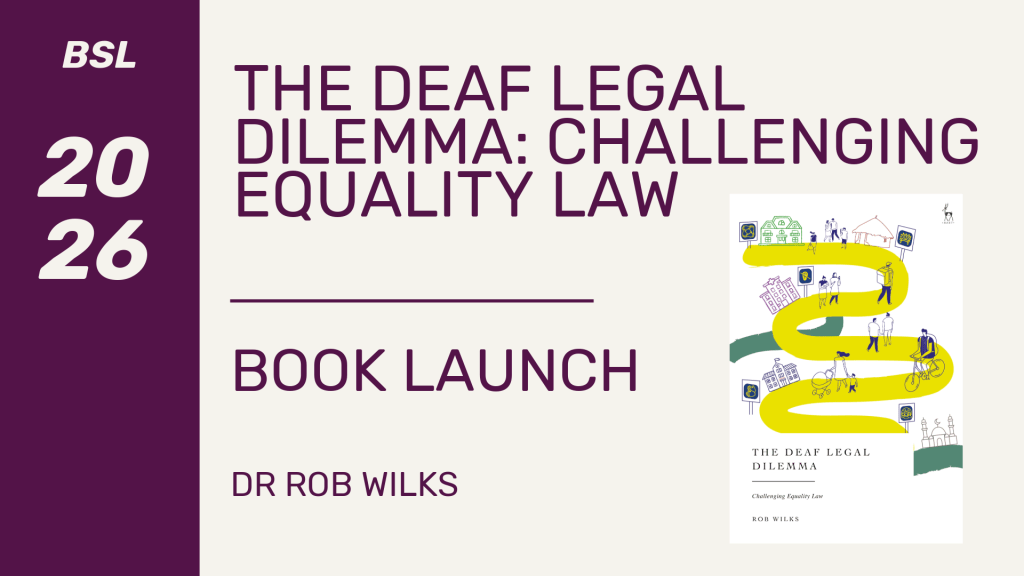
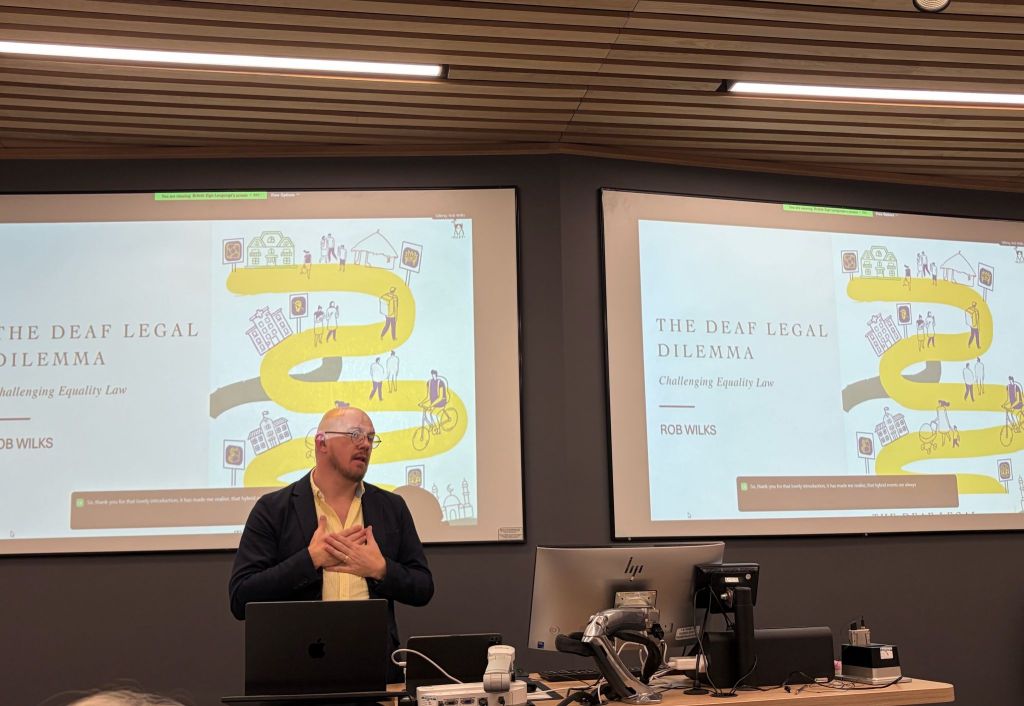
Following the Deaf Legal Dilemma book launch, I’ve been exchanging ideas with another academic about deaf identity, sign language, culture and rights. What began as a discussion about the social model of disability developed into something rather more complicated: who belongs to a sign language community, and what does that belonging mean in legal terms?
These questions are particularly relevant to my research on deaf rights and sign language laws. They also connect with arguments I explore in the book.
The more I thought about our exchange, the more I realised that several concepts I had previously treated as competing explanations might actually be describing different things.
Beyond the social model of disability
The social model of disability has undoubtedly been useful for deaf people. It helps explain how barriers within society, rather than individual impairments alone, create disadvantage. It also provides a basis for challenging inaccessible services and demanding reasonable adjustments.
But does it adequately explain the rights of deaf people as members of linguistic and cultural communities?
Consider BSL interpreting. Through a disability framework, interpreting is often understood as an adjustment that enables a deaf person to access a service. That is important, but it tells us relatively little about the preservation of BSL, its transmission between generations, or the institutions that sustain deaf culture.
Deaf schools, deaf clubs, cultural organisations, sign language broadcasting and deaf-led institutions are not simply mechanisms for overcoming disability-related barriers. They can also be understood as expressions of a collective linguistic and cultural heritage.
This raises an important distinction between ensuring that deaf people can participate in society and protecting the conditions that allow deaf communities to flourish.
Both matter. But they are not necessarily the same thing.
Language minority or culturo-linguistic?
Another question concerns the relationship between language and culture.
The language minority model places sign language at the centre of our understanding of deaf communities. This is understandable: sign languages are central to many deaf people’s identities, relationships and cultural experiences.
However, I have increasingly questioned whether deaf culture can be explained entirely through language.
Sign languages differ considerably across countries, yet deaf communities often share recognisable cultural experiences, histories and institutions. These include experiences of oralism, educational exclusion, collective activism and struggles for linguistic rights.
This is where I see value in distinguishing between the language minority and culturo-linguistic models.
The language minority model emphasises language and the cultural practices associated with its collective use. The culturo-linguistic model, by contrast, potentially provides a broader understanding of deaf culture and identity, encompassing shared histories, experiences, institutions and cultural practices that cannot necessarily be reduced to language alone.
An interesting possibility emerged during my recent exchange: perhaps language is better understood as one manifestation of a wider culture, rather than culture being treated as something that develops underneath language.
That is not to diminish the importance of sign language. Quite the opposite. It invites us to consider the wider cultural environment in which sign languages are created, transmitted and sustained.
These two models need not be competing explanations. They may instead illuminate different dimensions of deaf people’s collective experiences.
What are Sign Language Peoples?
This brings me to the concept of Sign Language Peoples (SLPs).
The significance of the word peoples is that it directs attention towards collective communities rather than simply individuals who use a particular language.
This potentially shifts the discussion away from asking whether an individual qualifies as a sign language signer and towards questions about shared histories, cultural institutions, community continuity and collective rights.
Initially, I struggled with this concept because it appeared to encompass hearing people, including children of deaf adults (CODAs).
If hearing people can belong to a SLP, how does that relate to the legal rights of deaf people?
But perhaps I was conflating two different questions.
One concerns membership of a linguistic and cultural community. The other concerns entitlement to particular legal rights.
They need not have identical answers.
I am beginning to think that SLPs and culturo-linguistic identity might operate at different conceptual levels. SLPs could describe a broader collective community, while culturo-linguistic identity concerns how individuals understand and express their relationship with that community.
That distinction is still developing in my thinking, but it opens up some interesting possibilities.
Who belongs, and who decides?
Defining the boundaries of a cultural community is rarely straightforward.
Consider CODAs. Some grow up immersed in sign language and deaf culture, maintain strong relationships with deaf communities and regard that cultural background as central to their identity. Others may have a much more limited connection.
It would be difficult to treat all CODAs as having identical relationships with deaf communities.
But there is another question that I find particularly important.
What about deaf people who were never given the opportunity to acquire sign language?
Many deaf people have grown up within educational and medical systems that prioritised speech and discouraged or excluded sign language.
Should their lack of sign language proficiency determine whether they belong to a deaf cultural community?
There is something deeply troubling about allowing the consequences of linguistic exclusion to become the basis for further cultural exclusion.
Paddy Ladd’s concept of Deafhood suggests that every deaf person possesses the potential to develop a deaf identity, even if they have been denied opportunities to acquire sign language or participate in deaf culture.
At the same time, we cannot simply ignore the importance of shared language, cultural participation and community relationships.
Perhaps the boundaries are necessarily less rigid than we sometimes assume.
There are also questions of power within deaf communities themselves. Who has the authority to define membership? Whose experiences are treated as representative? How do schooling, family background, class and access to sign language influence someone’s standing within a community?
These questions suggest that community membership is not simply a matter of identity. It also involves cultural capital, influence and opportunities to participate.
Does culturo-linguistic belonging create legal rights?
This is where my legal interests become particularly relevant.
I think we need to distinguish between belonging to a community and being entitled to particular rights.
For example, a hearing CODA may have legitimate interests in maintaining access to sign language and participating in the cultural life of a deaf community.
But that does not automatically mean they should have the same entitlement to reasonable adjustments as a deaf person experiencing disability-related barriers.
Similarly, some rights might be understood as individual entitlements, while others concern the collective preservation and development of a language or culture.
The legal basis, purpose and beneficiaries of those rights may differ.
This is not necessarily an argument against recognising the cultural or linguistic interests of hearing people connected to deaf communities. Rather, it is an argument for greater conceptual precision.
Who belongs to a community and who holds a particular legal right are different questions.
Recognising that distinction might allow us to take collective culturo-linguistic identity seriously without losing sight of the specific disadvantages that deaf people experience.
Should sign language laws protect more than language?
These questions also have implications for sign language laws.
Across the UK, different statutory approaches have emerged towards BSL and other sign languages. My current research examines whether these laws meaningfully advance language rights and deaf communities’ ability to influence decisions affecting their lives.
But perhaps another question deserves greater attention.
What exactly should a sign language law protect?
Is recognising a language sufficient? Or should the law also address the cultural institutions and social conditions necessary for that language to survive?
For example, language transmission depends on opportunities for children and families to learn sign language. Cultural continuity may depend on deaf schools, community organisations, educational provision, broadcasting and other institutions.
The experience of laws protecting minority languages, including Gaelic, offers a potentially useful comparison.
Rather than treating language as an isolated object of protection, perhaps we should think more carefully about the communities and cultural environments that sustain it.
Of course, there are difficult questions about how far the law should go, what obligations should be imposed, and who should determine priorities.
But those questions are worth asking.
An ongoing conversation
I haven’t reached a settled position on all of this.
Indeed, one of the most valuable aspects of exchanging ideas with other scholars is discovering that concepts we thought we understood are more complicated than they first appeared.
For me, three questions remain particularly important.
- Can deaf culturo-linguistic belonging extend to people who were denied the opportunity to acquire sign language?
- How should we distinguish collective culturo-linguistic membership from individual legal entitlements?
- And should sign language laws protect not only languages, but also the cultural institutions and communities that sustain them?
These questions sit at the intersection of deaf identity, language, culture and law. They also challenge us to think beyond accessibility towards the longer-term survival and self-determination of deaf communities.
I’d be interested to read how others approach them.
ChatGPT was used to help structure and develop this article from my own ideas and academic correspondence. The final text was reviewed and edited by me.

Leave a Reply