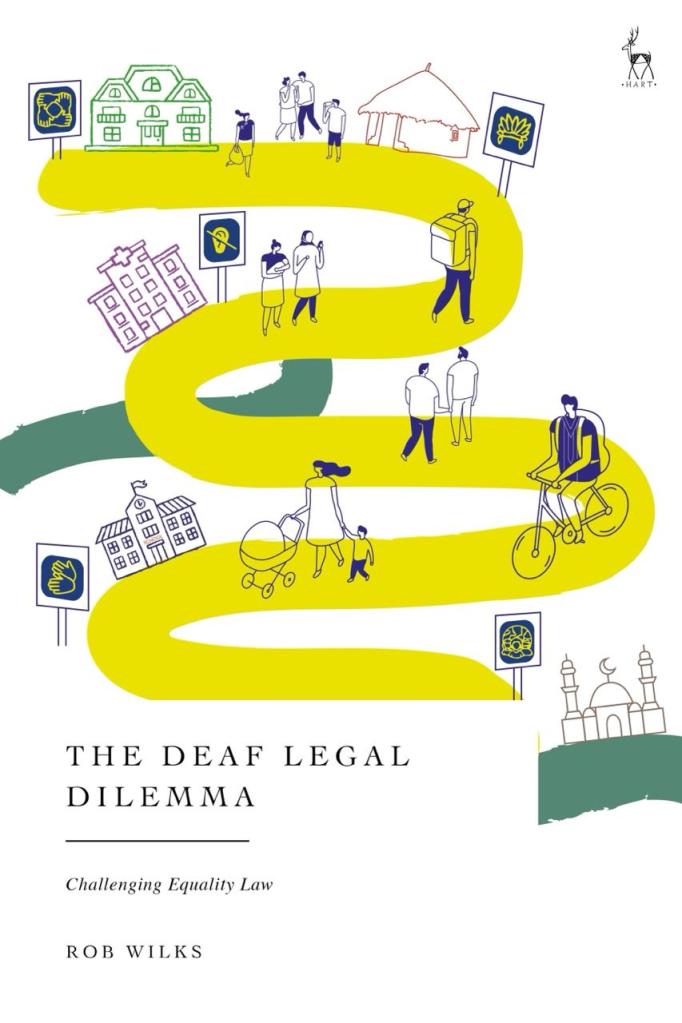
Dr Rob Wilks is currently working on a three volume series of books based on his doctoral thesis (2020). The first, The Deaf Legal Dilemma: Challenging Equality Law, is due to be published by Hart on 25 June 2026.
The second and third are currently in development, and their working titles are The Deaf Legal Illusion: Law and Rights and The Deaf Legal Exclusion: Case Studies Across Jurisdictions respectively.
Doctoral thesis
Equality law is not working for deaf people. The majority of deaf children attend mainstream schools without resource provision and are often denied the opportunity to engage with their deaf peers. Deaf people are likely to be in underemployment or unemployed and discrimination in the workplace is commonplace. There is evidence of injustice within the criminal justice system for deaf people, deaf people are not able to serve their civic duty as jurors, and their access to legal advice services is dire. Deaf prisoners suffer a ‘double sentence’ when in prison, and deaf people generally do not have access to healthcare services.
Thus, this thesis sought to explore why equality law is not working for deaf people, and what can be done to ensure that it does. In order to answer this research question, after a consideration of what evidence exists to suggest that deaf people continue to experience inequalities, an attempt is made to ascertain why the framing of deaf people as disabled is problematic, giving rise to what is termed the ‘Deaf Legal Dilemma,’ whereby deaf people are faced with a stark choice: accept the disability label, or have no access to any rights at all. There is then an attempt to determine which concepts of equality are relevant to deaf people, utilising a specific methodology that allows the author to categorise these concepts into either formal, substantive or transformative equality thus establishing a standard of measurement by which it is possible to determine how effective particular concepts of equality are in eradicating inequality.
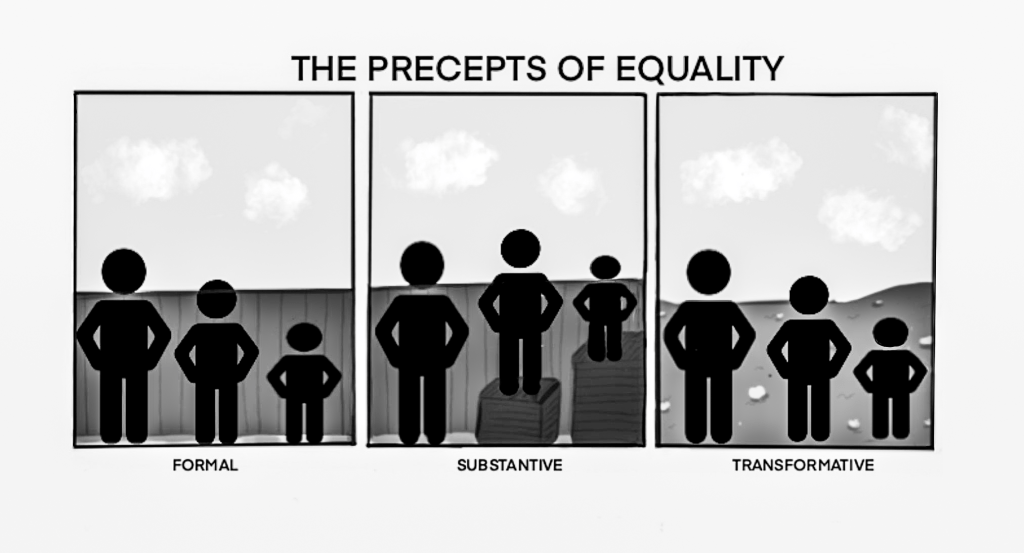
A doctrinal analysis of equality law in the UK is then undertaken, incorporating the Universal Declaration of Human Rights, the European Convention on Human Rights, the Equality Act 2010 and the United Nations Convention on the Rights of Persons with Disabilities. These are critiqued in order to establish how they apply or may apply to Deaf people, and how effective they are in addressing their inequalities. The findings of this analysis are that the instruments examined are not effective, and sign language recognition is proposed as a solution. The conclusion reached is that sign language recognition proffers a transformative approach to the Deaf Legal Dilemma and should – at least in the long term – give deaf people ‘equal and inalienable rights’ on par with hearing people, in full cognisance of their status as Sign Language Peoples.
The Deaf Legal Dilemma: Challenging Equality Law (vol 1)
Equality law is audist. Deaf communities around the world continue to encounter Deaf Legal Exclusion through legal frameworks that define them narrowly and restrict their rights.
The Deaf Legal Dilemma: Challenging Equality Law examines why these frameworks have not delivered equality in practice. It argues that the core issue is structural misrecognition: law protects deaf people only when they accept a definition based on disability. Sign language, culture and community are treated as secondary.
Drawing on doctrinal and socio-legal analysis of the Equality Act 2010, case law of the European Court of Human Rights, and the UN Convention on the Rights of Persons with Disabilities, the book critiques how equality law relies on narrow definitions of fairness. What appears to be inclusion is often a Deaf Legal Illusion: equality claimed in principle but absent in practice.
Formal, substantive and transformative precepts of equality and the Deaf Equality Concepts are explored, assessing their ability to reflect deaf people’s experiences.
The book analyses five models used to categorise deaf people in law and policy: disability, language minority, culturo-linguistic community, ethnic group and Indigenous group. In response, the Deaf Rights Model is proposed, which brings the five models together as complementary rather than competing.
The Deaf Legal Dilemma establishes Deaf Legal Studies as a field grounded in the priorities and expertise of deaf communities. It invites lawmakers, practitioners and scholars to rethink the purpose of the law and the structures through which deaf people are recognised.
The Deaf Legal Illusion: Law and Rights (vol 2)
Volume 2 will examine laws and policies that appear to include and protect deaf people. The themes under consideration are:
- Access to justice
- Participation
- Language recognition
- Health and social care
- Administrative governance (including procurement and commissioning).
Deaf Legal Exclusion: Case Studies Across Jurisdictions (vol 3)
Volume 3 will look at real legal cases from different countries to see what actually happens when deaf people rely on the law. This will include studying court decisions and, where possible, speaking directly to deaf people or legal professionals involved in important cases.
The current plan is to look at cases from the UK, Australia, Japan, Germany, Italy and Latvia.
 Dr Rob Wilks