
Rob Wilks is a Senior Lecturer in Law at UWE Bristol, specialising in employment law and legal skills. His work focuses on equality, anti-discrimination, and language law, particularly in relation to deaf people and sign language recognition. He is developing Deaf Legal Theory as a new perspective in legal jurisprudence and has a strong interest in bilingual deaf education, exploring the legal and policy frameworks that shape access to education for deaf children.
Originally from Newport, South Wales, UK, Rob is deaf and fluent in both British Sign Language (BSL) and English, teaching primarily through BSL. He lectures in employment law and legal skills across a range of undergraduate and postgraduate programmes at UWE Bristol.
Previously, he served as Senior Lecturer and Legal Practice Course Leader at the University of South Wales, and as Lecturer in Professional Law at Cardiff University.
Rob completed an LLM with Distinction in Law of Employment Relations in 2007 and was awarded a doctorate by the University of Leicester in 2020 for his research exploring whether equality law is working for deaf people and whether sign language recognition can achieve transformative equality.
He is currently writing a monograph titled Challenging Equality Law: The Deaf Legal Dilemma, due to be published by Hart Publishing in March 2026.
Deaf Legal Theory
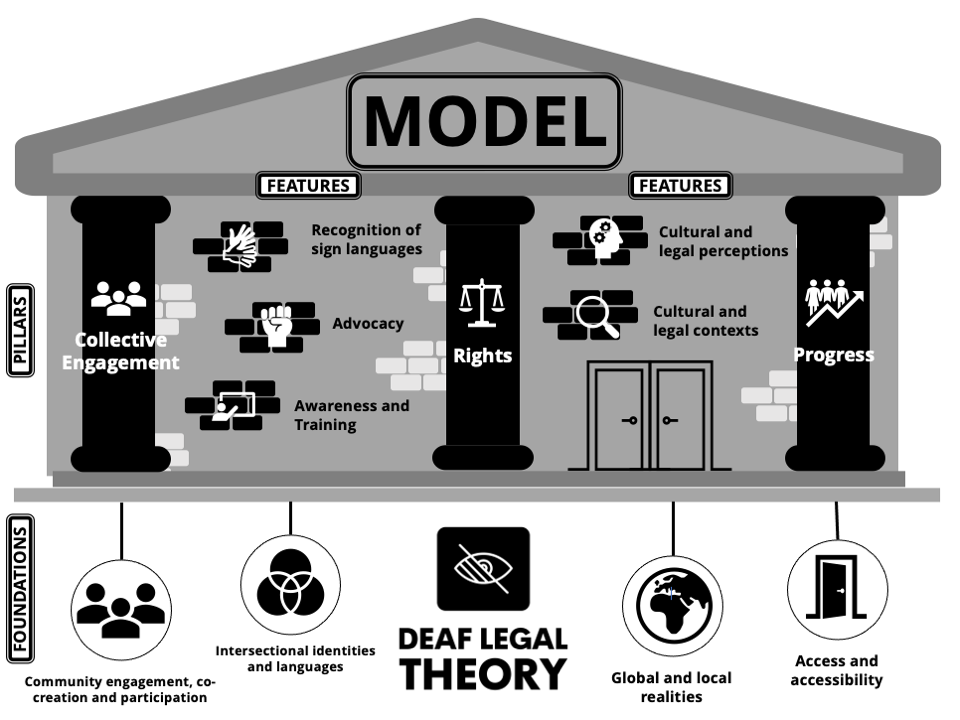
Rob is leading the development of Deaf Legal Theory, an emerging field that reimagines equality, law, and justice from deaf people’s lived experiences and epistemologies.
He led the Co-Producing the Deaf Legal Theory Model project (February 2024–February 2025), which developed the first co-produced model of Deaf Legal Theory. Building on this work, Rob is establishing the Deaf Legal Theory Foundation to create a global infrastructure for advancing research, education, and practice in the field.
He is Principal Investigator for the Strengthening Global Majority Representation in Deaf Legal Theory: A Pilot Project in Ghana (August 2025–July 2027), funded by UWE Bristol’s Vice-Chancellor’s Early Career Researchers funding scheme.
In parallel, Rob is leading the development of an edited volume, Developing Deaf Legal Theory, bringing together international perspectives on the application and evolution of Deaf Legal Theory.
Wales
In addition, Rob is Co-Investigator with Dr Christopher Shank at Bangor University and others on the AHRC-funded £1.04 million project Tackling Health Inequalities with and for the Deaf BSL-using Communities in Wales.

Rob is also leading a new project funded by UWE Bristol’s Higher Education Innovation Fund (HEIF) for 2025, focused on expanding research accessibility and engagement within the Welsh deaf community. The project builds on his recent article exploring how the Well-being of Future Generations (Wales) Act 2015 overlooks the Welsh deaf community, with community workshops in Colwyn Bay and Haverfordwest to share the findings and gather feedback. The project will produce a best-practice toolkit to support culturally responsive research engagement with deaf communities in Wales.
Deaf education
Rob is also actively involved in deaf education research. He co-leads the Deaf Education in the UK project with Rachel O’Neill at the University of Edinburgh.
This project has examined the impact of the British Sign Language (Scotland) Act 2015 on deaf education, and compared approaches to bilingual education in Scotland and Wales.
More recently, for a project funded by the National Deaf Children’s Society, Rob and Rachel explored the role, expectations, and professional standards for Teachers of Deaf Children and Young People, considering whether a formal code of practice is needed to support their work and to strengthen the quality and consistency of deaf education provision.
This research has produced several reports and recommendations aimed at improving BSL provision and support for deaf learners.

 Dr Rob Wilks