
Employee status is one of those topics that students often find difficult. The law is fragmented across multiple tests, heavily case-driven, and rarely applied in a linear way. How students see the structure of the law matters just as much as the doctrine itself.
The reflections in this post follow on from my Teaching through BSL post and are drawn from my teaching of the Employment Law module for LLB students at the University of South Wales (USW) between 2014 and 2022, and at the UWE Bristol (2024 to present). They show a progression in how I redesigned inherited teaching materials to improve clarity, reduce cognitive load for students, and support interpreter-mediated teaching.
The inherited starting point
When I began teaching Employment Law at USW, the slides on employee status were conventional and doctrinal (Figure 1). They set out the control test, the integration/organisation test, the economic reality test, and the irreducible minimum, supported by leading cases.
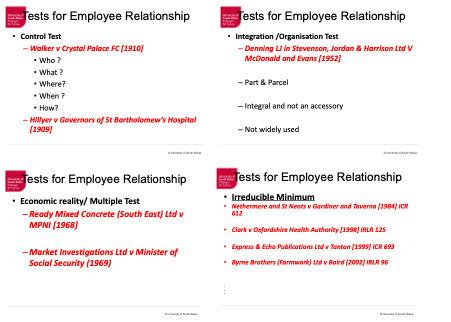
The content was legally sound, but the structure was implicit rather than explicit. Students were expected to infer how the tests related to one another and how courts actually reason through employee status in practice. The slides were text-heavy, visually flat, and cognitively demanding.
Telling students where they are going
My first intervention was simple but intentional: I introduced a clear overview slide at the start of each lecture (Figure 2). This set out what would be covered and how the topic was structured.
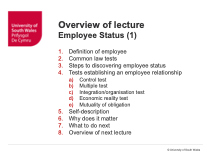
This provided students with an advance organiser and reduced uncertainty at the outset of a complex topic. It also supported interpreters by making the sequencing and focus of the lecture explicit from the beginning, rather than emerging gradually through dense doctrinal slides.
Externalising legal reasoning
The more substantive change came through redesigning the core slides using PowerPoint’s SmartArt tools to create structured visual frameworks (Figure 3).

Rather than listing tests, these slides model how the law works. They show the relationship between the different tests, how courts move between them, and how the question of employee status is ultimately resolved. In other words, they make visible what experienced lawyers do intuitively but students are rarely shown.
This approach reduces cognitive load by integrating doctrine and analysis into a single visual structure. It has been particularly effective in interpreter-mediated teaching contexts, where clarity of structure and reduced reliance on dense text significantly improve accessibility.
Depth without overload
To avoid oversimplification, I supplemented these frameworks with additional slides providing brief factual and legal context for each key case (Figure 4). These slides gave interpreters and students the background needed to understand why a case mattered, without cluttering the main analytical narrative.

This layered approach allowed students to engage with the law at different depths, while preserving a clear and coherent structure for the lecture as a whole.
Beyond USW
Although all four figures originate from my teaching at USW, the design principles underpinning them — explicit structure, visualised reasoning, and accessibility by design — have carried forward into my teaching at UWE Bristol (see Figure 5 for updated versions of the slides shown in previous figures).
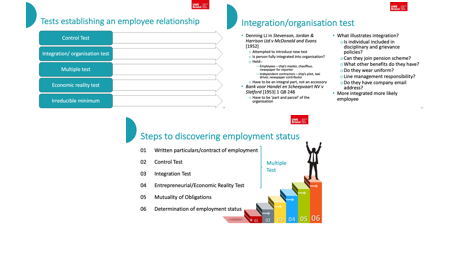
It is clear that structured overviews and analytical frameworks are now a standard feature of my lectures rather than a retrofit.
What this progression shows is a shift in how I think about teaching materials. Slides are not repositories of information; they are tools for thinking. Making legal reasoning visible is not a simplification of the law; it is a prerequisite for students being able to engage with it critically and independently.

 Dr Rob Wilks
Leave a comment