
I have published a new Action Plan and Research Toolkit designed to help researchers meaningfully engage with deaf communities in Wales. This practical resource is rooted in community feedback and reflects a shared priority: research should not just be done to deaf people — it should be done with them.
What the project was about
Funded by the University of the West of England’s Higher Education Innovation Fund (HEIF), this project aimed to expand how research reaches and involves the Welsh deaf community. A key goal was to make academic findings accessible by translating them into British Sign Language (BSL) and Welsh — breaking down barriers that too often prevent deaf people from accessing the knowledge that affects their lives.
The toolkit was developed from a series of events:
- A research sandpit in Swansea;
- Community workshops in Colwyn Bay (North Wales) and Haverfordwest (West Wales); and
- Follow-up feedback surveys with participants from across Wales.
Five principles for better research engagement
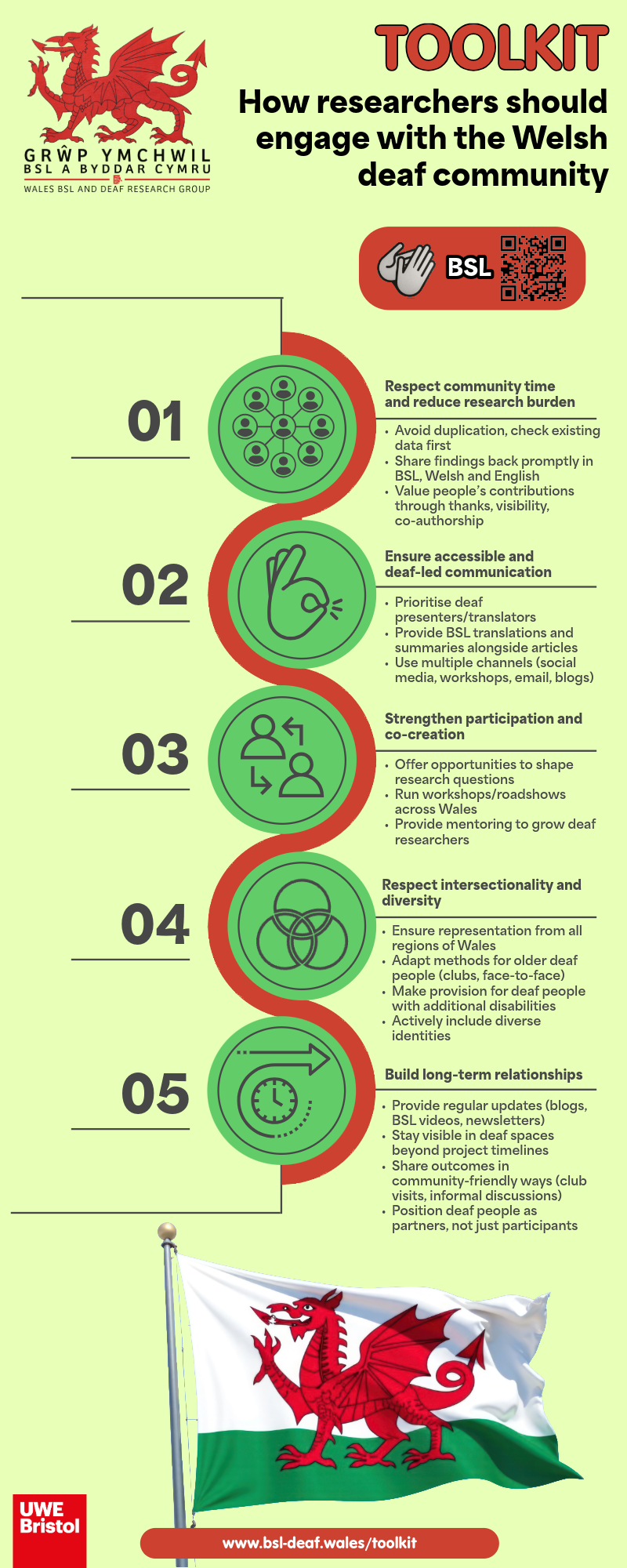
Drawing on lived experiences and rich community insights, the toolkit highlights five core priorities — each offering clear, practical advice for researchers:
1. Respect community time and reduce research burden
Deaf people often experience “research fatigue” when asked the same questions repeatedly without seeing results. Researchers are encouraged to:
- Avoid duplicating data collection;
- Clearly explain why input is needed;
- Share findings back in BSL, Welsh, and English; and
- Acknowledge contributions appropriately.
2. Ensure accessible and deaf-led communication
Participants stressed that communication isn’t just about translation — it’s also about leadership. Deaf presenters and translators should be prioritised wherever possible. The toolkit also highlights the importance of mixing online and in-person formats to ensure accessibility for all, from younger signers to older community members.
3. Strengthen participation and co-creation
There is strong interest among deaf people to be involved beyond simply giving feedback — from shaping research questions to training and mentoring roles. Researchers are encouraged to:
- Recruit through trusted networks;
- Offer mentoring or shadowing opportunities; and
- Invite deaf people to help design research methodologies.
4. Respect intersectionality and diversity
The deaf community is not monolithic. Experiences differ widely across regions, age groups, disability intersections, and social identities. It’s crucial that research participants reflect this diversity, and that their unique perspectives shape the work from the outset.
5. Build long-term relationships
Too often, research is treated as a one-off interaction. The toolkit urges researchers to invest in sustained dialogue with deaf communities:
- Ongoing updates through blogs and newsletters;
- Regular visits to community spaces; and
- Accessible summaries of findings that benefit the community long after the project ends.
Why this matters
This Action Plan and Toolkit doesn’t just offer tips — it represents a shift in how research is experienced by deaf people in Wales. By centering cultural accessibility, co-creation, and genuine partnership, it lays the foundation for research that is not only more inclusive but also more impactful.
For researchers, community advocates, and anyone interested in socially responsible research practices, this resource is a timely reminder: meaningful engagement starts with listening — and ends with shared outcomes.
Toolkit

 Dr Rob Wilks
Leave a comment